NEW FUNDING OPPORTUNITY! C-Path’s TRxA Announces its First Biologics-focused RFP for Academic Investigators
C-Path Translational Therapeutics Accelerator (TRxA) today announced its inaugural biologics-focused Request for Proposals (RFP)..




How does TRxA Help Bridge the Drug Development “Valley of Death?”
Drug development has several phases that are categorized as discovery (preclinical), development (clinical trials), and commercialization, once approved by regulatory agencies such as the U.S. Food and Drug Administration. For many reasons, the transition from discoveries in the academic environment to drugs entering the pipelines of pharmaceutical companies is often a place where significant opportunities for innovative therapies are lost – frequently referred to as the drug development “valley of death.”

TRxA leverages C-Path’s proficiency in translational and regulatory science to bridge the drug development “valley of death” by providing academic researchers with funding and guidance for the advancement of novel therapeutics from the lab to clinical trials and, ultimately, commercialization and patient care.

TRxA operates as a not-for-profit drug accelerator providing the following for academic researchers who have applied for and received a grant award:
To learn more about TRxA, be informed when the award application period opens, and how to apply for an award, contact us at TRxA@c-path.org or subscribe to our updates.
TRxA is made possible by a grant from the Research Corporation Technologies, Inc’s Frederick Gardner Cottrell Foundation.
TRxA’s focus is translating early-stage novel therapeutics into Investigational New Drug (IND) supporting data packages that garner interest for licensing opportunities; we are helping “BRIDGe” (Breakthrough Research and Innovation in Drug Development Grants) the drug development valley of death. Projects eligible for TRxA BRIDGe funding and support include early lead optimization through IND-enabling studies of small molecule therapeutics. Biologics, including natural peptides or antibodies, cell and gene therapy applications, and diagnostic and medical devices are not eligible at this time; nor are drug repurposing initiatives.
TRxA funding and support is reserved for faculty at universities and non-profit institutions, anywhere around the world. Awards are not limited to specific therapeutic indications. TRxA offers funding and support for three (3) types of translational projects, ranging from early lead optimization to IND-enabling studies.
Early lead optimization to late lead series. Funding up to $250,000 (direct + indirect costs) for up to 1 year.
Late lead series to selection of clinical candidate. Funding up to $500,000 (direct + indirect costs) for up to 1 year.
Candidate selection through IND enabling studies. Funding up to $1,000,000 (direct + indirect costs) for up to 1 year.
*Stage 3 proposals require pre-consultation with TRxA prior to submission
Funds awarded through BRIDGe are provided for the purpose of carrying out research studies directly related to the project as documented in the approved research plan (either at the institution or through a contract research organization). Principle Investigators are required to concisely outline and justify direct project costs during the application process. Indirect costs are capped at 10%.
To be eligible for BRIDGe funding and support, investigators need to hold a faculty appointment at a university or non-profit research institution, and intellectual property (IP) associated directly to the project cannot yet have been out-licensed.
TRxA accepts applications during its annual Request for Proposals, which will be announced in January of each year on this website and via email to those who have subscribed to TRxA news and updates.
To submit a pre-proposal application in response to the annual RFP, click here to access TRxA’s grants portal. More information about the application process is available in TRxA’s Guidance Document for Applicants. A User’s Guide for the grants portal is available here. The pre-submission consultation form is available here.
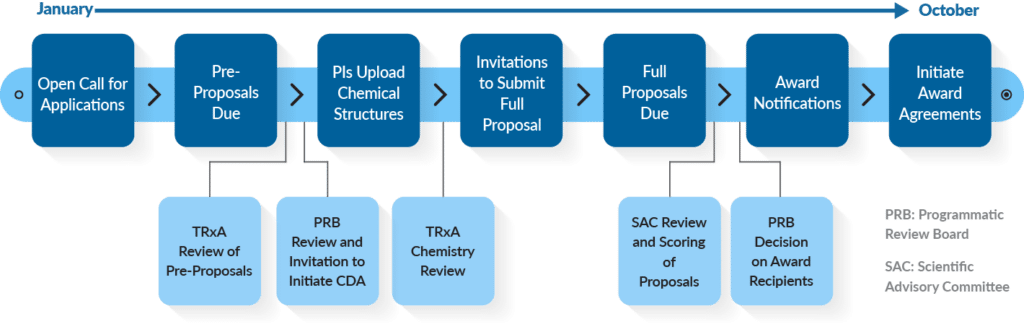
It is also recommended that principal investigators (PIs) coordinate with their university’s tech transfer and/or grants and contracts office in advance of applying to 1) make them aware of plans to submit an application and 2) provide an opportunity for review of the TRxA award agreement template to ensure the terms of a TRxA award are, in principle, acceptable.
During the application process, the TRxA team is available to meet with PIs via teleconference to answer any questions about requirements or the award process. These 30-minute consultations can be requested via email to TRxA@c-path.org.

Entry criteria
Success criteria
Entry criteria
Success criteria
Entry criteria
Success criteria
To learn more about TRxA, be informed of when the award application period opens, and how to apply for an award, contact us at TRxA@c-path.org or subscribe to our updates. PIs are also encouraged to review the FAQ section of this website for additional details about the program.
TRxA is made possible by a grant from Research Corporation Technologies, Inc’s Frederick Gardner Cottrell Foundation.
Bill Montfort, PhD
University of Arizona
Glioblastoma (GBM) is a highly invasive brain neoplasia with a median patient survival of 12-15 months from initial diagnosis. The highly refractory and heterogenous nature of GBM is primarily attributed to the large population of glioma stem cells (GSC) which exhibit remarkable plasticity and drug-resistance. Hence, till date, all repurposed kinase inhibitors exhibiting blood-brain-barrier penetrance failed glioma clinical trials. Loss of key tumor suppressors like PTEN and NF1 coupled to oncogenic activation of receptor tyrosine kinase PDGFRA and lipid kinase PI3KCA drive proliferation and invasiveness in GBM. Furthermore,the WNT-β-catenin signaling pathway maintains glioma stem plasticity through transcriptional upregulation of MYC, SNAIL, SOX2, NANOG. Hence, a successful therapeutic strategy will require pleiotropic targeting of diverse signaling pathways in glioma which promote proliferation and plasticity. As such, over the last 2 years, our international team has embarked on a medicinal chemistry project, screened over 250 molecules, and discovered ablood-brain-barrier penetrant, first-in-class PI3KCA/PDGFRA/WNT pathway inhibitor with a goal to start clinical development by 2026-27 for glioma therapeutics. DYR726 has been benchmarked against multiple kinase inhibitors currently in glioma clinical trials and exhibits asuperior in vitro biological profile in targeting a panel of primary patient-derived adult and pediatric glioma cells and 3D GSCs. Importantly, DYR726 exhibits a therapeutic index of 10-fold between GSCs and normal neurons suggesting potential glioma specificity. Although kinase inhibitors have not been successful in targeting glioma in the clinic, the pleiotropic nature of DYR726 may provide an effective therapy for patients diagnosed with glioma.
Yong-hui Jiang, MD, PhD
Yale School of Medicine
Jian Jin, PhD
Icahn School of Medicine at Mount Sinai
Prader-Willi syndrome (PWS) is caused by paternal deficiency of genes in chromosome15q11-q13 region. Specifically, a cluster of SNORD116s between SNRPN and UBE3A are responsible for the key features of PWS. The allele specific epigenetic modifications at thePWS imprinting center (PWS-IC) are postulated to regulate the silent expression of PWS genes in the maternal allele. The involvement of epigenetic regulators renders PWS one of the best opportunities to explore epigenetic therapy by reactivating the expression of paternally expressed PWS genes from the silenced maternal chromosome. In our publishedstudy of a high content small molecule drug screen, we identified and validated two compounds (UNC0642 and UNC0638) that reactivated/unsilenced the expression of SNRPN and SNORD116 in both human PWS cells and a PWS mouse model. These compounds are selective inhibitors of histone H3 lysine 9 (H3K9) methyltransferases G9/EHMT2 andGLP/EHMT1. Treatment by UNC0642 via intraperitoneal injection rescued perinatal lethality and improved the growth in a PWS mouse model without any observed toxicity. Structural optimization of UNC0642 has provided orally bioavailable G9a inhibitors with improved penetration to the CNS. Treatment of lead inhibitors in PWS cells and in a mouse model reactivated the expression of SNRPN-EGFP from the maternal chromosome. The proposed study will extend this proof-of-concept study and aims to produce data to support FDA IND enabling studies for the lead candidate.
To learn more about our projects, such as who we fund, what we fund, how our funding works and more, visit our FAQs section here.
Maaike Everts, PhD,
Executive Director
Mark Drew, PhD
Director of Drug Discovery & Development
Michelle Morgan
Associate Director
Kyla Oetting
Project Coordinator II
Klaus Romero, MD, MS,
Chief Science Officer, Chief Executive Officer
Terina Martinez, PhD,
Executive Director, Rare and Orphan Diseases
Sergey Rakhilin, PhD,
Executive Director, Critical Path for Sickle Cell Disease Consortium
TRxA is made possible by a grant from Research Corporation Technologies, Inc’s Frederick Gardner Cottrell Foundation.